California Legal Case Counting Employees Orange County Perf Arts
Articles Posted in Employment Arbitration
U.S. Supreme Court Weighing California Labor Law


The U.S. Supreme Courtroom recently heard arguments in a dispute over the California labor law that gives private attorneys the right to pursue litigation on behalf of workers (even if they agreed on their own to intervene) and to collect penalties on the state'due south behalf for wage and hour violations. As our Riverside employment lawyers tin explain, the instance is being closely watched, as it is an of import test of whether employers can shield themselves from employment lawsuits with arbitration clauses that prohibit group or form action lawsuits. 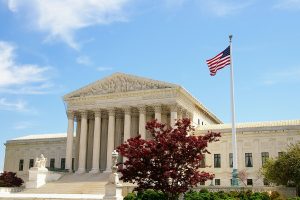
The case is Viking River Cruises v. Moriana. The principal question is whether the Federal Arbitration Act requires enforcement of bilateral mediation agreements, provided an employee tin't raise representative claims, including those under California'southward Private Attorneys Full general Act (PAGA).
During oral arguments, the court's bourgeois justices spoke very piffling, while the liberal justices were more song in their defense force of the state labor law.
The Private Attorneys General Act was passed in 2004 and allows private attorneys in California to sue employers and collect penalties for violations of the land's labor lawmaking. The underlying reason for the act? Rampant labor law violations, particularly in the post-obit industries:
- Restaurants.
- Motorcar Washes.
- Construction.
- Garment companies.
- Agriculture.
The state simply doesn't have plenty staff to adequately police these industries. PAGA lawsuits are often complaints of unpaid overtime work or wage theft. The police allows 75 percent of penalties nerveless to go to the state. The remainder goes to the affected employees and attorneys. Keep Reading ›
California Ban on "No Rehire" Clauses Will Likely Lead to More Retaliation Claims
California may see an increase in workplace retaliation claims since Associates Bill 749 , which bans no-rehire clauses with express exception in employment dispute settlements, was enacted this month. 
Prior to the passage of this bill, information technology was common practice for companies to settle bigotry or harassment claims with employees with a settlement that included a no-rehire clause. These provisions tin can vary in scope, but usually indicated that whatsoever time to come awarding for employment past that person wouldn't be considered, and if the worker was hired past run a risk, he or she would be terminated automatically.
The California Bedchamber of Commerce had argued the police wasn't necessary considering there were already existing laws against overly-broad no-rehire clauses (specifically, Business organisation and Professional Code section 16600).
The new law, codified in the California Lawmaking of Civil Procedure section 1002.5, indicates that no understanding to settle an employment dispute should contain any provision that prohibits, prevents or otherwise restricts an aggrieved person who is settling from obtaining future employment with that employer or any parent company, partition, affiliate, subsidiary or contractor. Companies can include no-rehire provisions in cases where the visitor made a good faith conclusion that the person signing committed sexual harassment or sexual assault OR where there was a legitimate (i.e., non-discriminatory, non-retaliatory) reason for firing that person. There is as well an exclusion for severance agreements. Continue Reading ›
California Courts Naught Not-Solicitation Clauses in Employment Agreements
Non-solicitation clauses in California employment agreements have been deemed illegal in California per two recent courtroom decisions. This includes out-of-state employers with California employees. Orange County employment attorneys are encouraging companies to review their employment agreements and consider removing non-solicitation clauses that may be in conflict with land law.
Non-solicitation agreements are provisions in employment contracts (sometimes standalone contracts) wherein an employee agrees he or she will non try to solicit customers or clients of the employer for his or her personal benefit or for that of a competitor if/when he/she leaves the firm. Non-solicitation agreements can also encompass an employee's agreement not to solicit other employees to go out once he/she quits.
Restrictive Covenants in California Labor Code
California has some of the strongest worker rights provisions in the state. For example, California Business organization and Professions Code department 16600 states that all employment contracts that would go along anybody from engaging in a lawful profession, concern or trade is void.
Courts in California have long held that it is against public policy to restrict former employees' correct to work for competitors. Further, land courts have soundly rejected the argument put forth by the inevitable disclosure doctrine, which asserts employees who immediately go work for a competitor is going to inevitably disclose or use merchandise secrets of the former employer. In the 2008 case ofEdwards v. Arthur Andersen LLP,the California Supreme Court ruled previous workers are entitled to solicit the clients of quondam employers – assuming they don't exercise so using their former employer's trade secrets or confidential data while doing and then.
This ruling marked a shift from the 1985 ruling by a California Court of Appeal in Loral Corp. five. Moyes, in which justices declined to void as unenforceable an employee agreement restriction indicating the employee was not allowed now or in the futurity to harm, interfere, impair or disrupt the concern of the former employer past interfering with or "raiding" its employees, business relationships, agents, representatives, customers, vendors, etc. The clause created an express exception for being employed by or engaging with a competing business. The courtroom didn't expressly allow employment contracts with non-solicitation agreements, but rather ruled the i in question wasn't an obvious, unenforceable brake on fair trade. Continue Reading ›
SCOTUS Easily Huge Pro-Worker Victory to California Truckers in Forced Arbitration Example
The U.Due south. Supreme Court handed a meaning victory to American workers in a case that started as a California employment lawsuit over forced arbitration by independent contractors working in transportation. The decision in New Prime number Inc. v. Oliveira was a somewhat surprising upshot given that the court in contempo years has a history of favoring corporate interests over workers. (Note: Justice Brett Kavanaugh, who assumed the bench after the oral argument, did not participate in the decision, but the ruling was unanimous.) Every bit our Los Angeles employment arbitration lawyers can explain, this will let hundreds of thousands of independent contractors nationally to take their cases to court, rather than be mandated to settle them quietly before an arbitrator.
The problem with arbitration – whether it's a example of production liability or bounds liability or unfair wages or sexual harassment – is that it tends largely to favor employers and big corporations. The arbitrators are paid by the companies, the outcomes are not public (depriving the public of pertinent information regarding unfair or dangerous business practices) and even when cases are decided in plaintiff's favor, they tend to exist lesser than what 1 could expect to receive when cases go to a jury.
This case stems from a dispute between a trucking company employer and a truck driver, who was hired to complete some 10,000 miles of driving every bit an "apprentice" before he could wait payment. Even later that, he was expected to bulldoze for 30,000 miles as a trainee, during which time he was paid $4 hourly. Then, once he was finally designated a total-fourth dimension driver, he was notwithstanding misclassified as an independent contractor, as opposed to an employee. He was required to lease the truck he collection from the accused, purchase his own equipment from their store and purchase his ain diesel fuel, ofttimes from gas pumps that were owned by the defendant. In whatsoever other employment situation, the employer would be the one basis the neb for these expenses. The result, in several cases, was that the "independent contractor" truck driver would accept to deduct these expenses from his income, meaning sometimes his paychecks actually wound upwards being negative. He was paying this company to work for them. Continue Reading ›
Criminal Groundwork Inquiries by California Employers Narrows with Approval of SB 1412
But certain groundwork data of ex-convicts will be searchable for employment now that Governor Jerry Brown has signed SB 1412, which apology Section 432.7 of the California Labor Code. Equally our Riverside employment attorneys can explain, the measure stipulates that employers conducting criminal background checks on task applicants may just enquire about/ weigh convictions that are relevant to the job for which a prospective employee is applying.
The new California employment law, effective Jan 1, 2019, applies not just to private individuals and corporations but also public agencies. Companies won't be barred from conducting criminal background checks on job applicants, but they will exist restricted in doing so. It doesn't stop public or private employers from conducting criminal background checks as required by local, country or federal law. It does however replace the provision that allows employers to inquire almost "criminal convictions" to instead say, "item convictions."
Doesn't California Law Already Protect Ex-Convict Job Seekers?
As your Riverside employment attorney can explain, California police does to an extent already protect those seeking a job from existence required to reveal certain information. However, SB 1412 takes it a pace further in shielding more workers from discrimination based on prior criminal history. Continue Reading ›
The State of Employee Rights Afterward Supreme Court Determination on Unions
The Supreme Court'due south recent decision in the instance of Janus v. American Federation of State, Canton, and  Municipal Employees chop-chop rose to landmark status in employment law. The v-4 ruling past the loftier court adamant information technology is unconstitutional to force nonunion workers to pay fees to unions in the public sector. Justices for the majority decisions explained that forcing workers to financially dorsum an arrangement whose views they did not necessarily hold with was a violation of their Outset Amendment right to free spoken communication, according to a CNBC report. The decision overturned the 1977 Supreme Courtroom ruling in Abood five. Detroit Lath of Education, which stated fees could be collected for commonage bargaining, but non for political purposes. Some believe, however, that by nature collective bargaining and union practices are political.
While the ruling does not bear upon the private sector directly, the spirit of the decision certainly sets a precedent for legal disputes with private employment unions. It also helps bolster laws that already exist in 27 states which foreclose agreements between unions and employers to strength all employees who are part of a bargaining unit of measurement to contribute to matrimony ante. The ruling is viewed by many as a victory for private liberties. Continue Reading ›
Amanuensis Wants Out of Contract After Claims of Assault
A longtime agent in Tennessee has filed a lawsuit confronting Los Angeles-headquartered Bureau for the Performing Arts alleging a hostile piece of work environment and seeking to exist released from his contract. The lawsuit was filed in the U.Southward. District Court, Middle District of Tennessee. Plaintiff claims executives at the bureau have tried to border him out and have his clients, sent hostile and abusive emails to him, and threw him into a wall during an argument, according to a report from Tennessean. The agent alleged an internal research into the events led to a vague response from the visitor, essentially calling on all parties involved to follow the rules and get along. Plaintiff establish this conclusion unacceptable, and believes APA's tolerance of a hostile work environs frees him of his contract, which is set to expire in 2019. Continue Reading ›
Supreme Court Takes Shot at Employee Course Action Lawsuits
In a 5-4 decision, the U.S. Supreme Courtroom fabricated it significantly harder for workers to join together to stand up against their employer.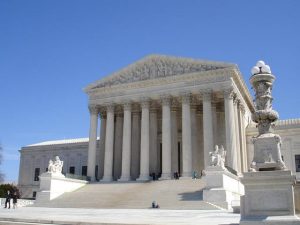 The highest courtroom in the state determined it is permissible for employers to include language in hiring contracts banning employees from joining grade-action lawsuits, according to an ABC News report. This disheartening revelation flies in the face of the 1935 National Labor Relations Act, which was drafted to protect employees' rights to organize and take collective activity to fight for their own interests.
The supporting justices seemed to favor instead the Federal Mediation Act of 1925, which validates arbitration clauses, making it legal for employers to bind an employee'southward right to sue their employer as a term of employment. This forces employees who have signed an arbitration understanding to address their grievances without filing a lawsuit. Instead, they would have to handle disputes individually through a third political party arbitrator, often hired by the company whose actions are in question. Continue Reading ›
Ex-Uber Employee Seeks to Open up Closed Doors of Forced Arbitration
Nosotros've heard all besides many stories since the emergence of the #MeToo movement near women who wanted to come forward with their accounts of workplace sexual misconduct, but their companies had created loopholes that made it nigh incommunicable or too risky to get public. One sometime Uber employee is kicking downwards some of those barriers and working aslope the California Assembly to go far happen.
The former Uber engineer drew national attention when she previously wrote a blog post nearly alleged sexual harassment and questionable practices within the visitor, according to Tech Crisis. Her backbone to speak upwardly led to the resignation of Uber'south and so CEO terminal summertime. Now the ex-employee is supporting a bill that will help women in situations similar hers to be able to seek public legal activeness. Assemblywoman Lorena Gonzales Fletcher (D-San Diego) introduced AB-3080, a bill that addresses one of the major ways companies endeavour to silence internal complaints: forced arbitration.
Continue Reading ›
LA Workers' Congress Renews Fight for Workers' Rights
One of the best ways workers can shield themselves from discriminatory practices at work is through the employ of organized resistance to unscrupulous practices past employers. When a worker'due south rights accept been violated, in that location may be the possibility of taking legal action only many labor unions strive to prevent such violations before they occur.
 Co-ordinate to a recent news article from People'southward Globe, the Los Angeles chapter of the American Federation of Labor and Congress of Industrial Organizations (AFL-CIO), has pledged to renew their efforts to form an "inseparable resistance to illegal and otherwise unfair employment practices" committed by diverse employers in Los Angeles and beyond California. Continue Reading ›
Source: https://www.orangecountyemploymentlawyersblog.com/category/employment-arbitration/
0 Response to "California Legal Case Counting Employees Orange County Perf Arts"
Post a Comment